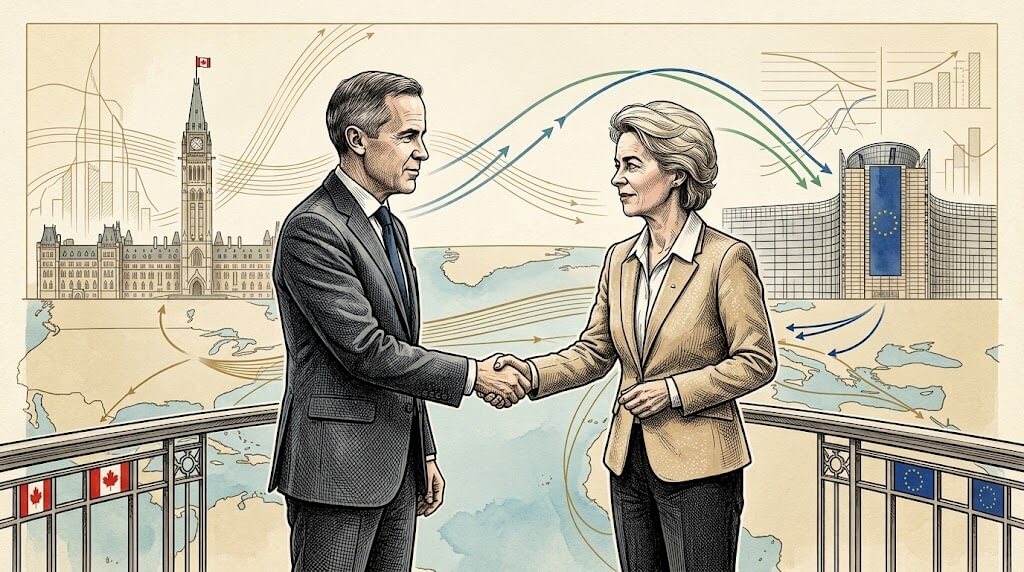
On September 16, 2026, European Commission President Ursula von der Leyen delivered her annual State of the European Union address in Strasbourg, with Canadian Prime Minister Mark Carney seated as guest of honor. Al Jazeera reports he is the first foreign head of government to attend the address.
What von der Leyen offered was to work with Carney on opening the door for Canada to become the EU’s first associate member.
That is a proposal, not an instrument. There is no treaty category for it, no legal text, and no timetable. Canada’s ambassador-designate to the EU, Jonathan Wilkinson, told reporters the two sides remain far from landing it.
The online reaction moved faster than the analysis. Posts framing this as an immediate rupture with Washington—complete with lost jobs and trillion-dollar figures—spread within hours. Look past the framing and the mechanics tell a narrower, far more disciplined story.
Canada is not leaving the American orbit, and it is not adopting the euro. What Carney ran in Strasbourg is a sovereign balance sheet hedge: the same structure he would have built for a distressed corporate client, deployed here at the scale of a G7 economy.
That associate membership has no legal architecture yet does not weaken the reading. It supports it. The value of an outside option comes from its credibility, and credibility arrives long before ratification.
Pricing Single-Buyer Supply Exposure: How Corporate Boards Stress-Test Trade Concentration
Corporate boards routinely confuse geographic proximity with commercial resilience. An independent strategic pre-commitment assessment evaluates single-buyer dependence as a balance-sheet discount governed by three operational tests:
- 01 The Captive Buyer Penalty: Sending ~70% of production to a single counterparty inevitably leads to unilateral pricing discounts, where regulatory determinations can destroy margins overnight.
- 02 Physical Collateral Matching: Outside options only hold value if backed by physical inputs the secondary counterparty cannot substitute (e.g., Canadian potash, CRM Act lithium, and hydro-based CBAM differentials).
- 03 Pre-Commitment Outside Option Viability: Credible fallback corridors neutralize bilateral hold-up dynamics long before treaties are signed, resetting terms before the 2026 CUSMA review locks in capital costs.
THE CAPTIVE DISCOUNT
Converting 70% Concentration into a Bidding Contest
Canada supplies most of America’s imported potash, holds critical battery minerals, and moves roughly four million barrels of oil a day into the United States. Ahead of the 2026 CUSMA review, Carney is using that physical leverage to turn Canada’s core vulnerability—around 70% of exports going to a single buyer on NPR’s current count—into a bidding contest between Brussels and Washington.
The commercial pressure is no longer hypothetical:
- Washington has imposed 50% tariffs on specified Canadian goods.
- Additional restrictions have been announced, including bans on selected Canadian dairy, alcohol, and auto imports.
- On the day of the Strasbourg address, Donald Trump signed a memorandum directing federal procurement agencies to strip out Canadian-origin products.
For any multinational still planning around an unhedged North American supply corridor, that baseline assumption no longer holds.
WHAT ACTUALLY CHANGED IN STRASBOURG
Separating Undefined Instruments from Empty Ones
Commentary split quickly after the speech. Supporters read the address as a rebuke to Donald Trump’s tariff threats. Skeptics called associate membership a label with no treaty enforcement behind it.
On the law, the skeptics are right. No such category exists in the current EU treaties. Von der Leyen’s own framing was a move from CETA toward an "alliance for the future, a common space for prosperity and economic security," and Reuters notes that the legal route has not been set out.
Where the skeptics go wrong is in treating an undefined instrument as an empty one.
The EU’s existing toolkit runs from Article 49 accession through EEA membership, association agreements, customs unions, the Swiss bilaterals, and trade agreements such as CETA. None of it was built for an overseas partner of Canada’s size and profile. Bringing one in means the Commission has to design something new. On the Atlantic Council’s reading, the willingness to open that file is itself the decisive signal.
Brussels did not open it for symbolic reasons. It shares a structural vulnerability with Ottawa. Both are heavily exposed to a United States that now treats tariffs as an instrument of pressure rather than a settled policy. Europe is absorbing US tariffs on top of a severed Russian energy relationship, and its manufacturing base is short of affordable physical inputs. Canada is walking into a contested 2026 CUSMA review while sending roughly seven in ten export dollars across one border, under 50% tariffs, with bilateral talks already collapsed.
That is the position of a company whose largest customer has stopped taking calls.
HOW A CENTRAL BANKER READS CANADA’S POSITION
Unwinding Portfolio Concentration Across Three Fronts
Carney’s approach follows from his training. Having governed both the Bank of Canada and the Bank of England, he reads a trade relationship the way a portfolio manager reads a company with concentrated customer risk.
A business earning 75% of its revenue from one client—particularly a client with unilateral pricing power—trades at a captive discount. The arithmetic is familiar to any executive: one tariff announcement, or one Section 232 national-security determination, can eliminate operating margins in an afternoon.
Bringing Canada into the EU’s industrial procurement conversation puts a 450-million-consumer counterparty across the table from American buyers. Direction matters more than current legal status when federal procurement is being actively weaponized.
A commodity with only one buyer sells cheap, as the persistent Western Canadian Select discount to WTI demonstrates. A second sovereign market, even an incomplete one, gives Canadian output somewhere else to be priced.
If Washington guts CUSMA during the 2026 review, Canadian exporters are not starting from zero. The transatlantic channel already exists under CETA. Whether it widens depends on what associate membership turns out to contain.
THE PHYSICAL COLLATERAL: POTASH, BATTERY METALS, AND CBAM
Operationalizing the Transatlantic Spread
A sovereign hedge requires physical collateral the counterparty wants and cannot easily source elsewhere. What Europe is short of matches what Canada extracts, which is why this conversation centers on minerals and energy rather than diplomatic goodwill.
Agricultural Leverage: According to the USGS, Canada supplied about 79% of US potash imports in 2020–2023, with industry estimates running higher. If terminals in Montreal, Halifax, and Churchill redirect even a fraction of that tonnage toward European buyers, US agricultural input costs rise at a vulnerable point in the domestic electoral calendar. Redirection is not instant—it depends on port capacity, freight economics, and existing contracts. What has changed is that the option now exists.
Sourcing Arbitrage under the CRM Act: The EU’s Critical Raw Materials Act sets a 2030 benchmark: no single third country should account for more than 65% of the bloc’s consumption of any strategic raw material across any supply-chain stage. Whether associate status grants Canadian lithium, graphite, and rare earths preferential standing under that framework remains undecided. It is one of the key operational clauses to watch.
The Transatlantic CBAM Spread: Europe’s Carbon Border Adjustment Mechanism (CBAM) applies border charges to carbon-intensive imports, including aluminum, and entered its definitive phase in 2026. Canadian smelters running on the hydro grids of Quebec, British Columbia, and Manitoba carry low embedded emissions. This translates into a structural cost advantage over higher-carbon competitors.
Carbon accounting standards, not diplomatic goodwill, represent the binding constraint on capturing transatlantic pricing differentials.
Stratimind Strategic Decision Lens
THE REAL TARGET: THE 2026 CUSMA JOINT REVIEW
Eliminating the Bilateral Hold-Up Trap
None of this is about leaving North America. It is about manufacturing leverage for the negotiation that determines Canada’s economic trajectory: the 2026 CUSMA Joint Review.
Article 34.7 sets the clock. The agreement runs sixteen years; if all three parties confirm at the mandatory six-year review in 2026, the term rolls forward another sixteen. Non-confirmation does not end the agreement. On the Congressional Research Service’s reading, it pushes the parties into annual joint reviews through 2036, while preserving each party's right to withdraw on six months’ notice. The practical exposure is not an immediate cliff, but a decade of compounding uncertainty that inflates the cost of capital.
Carney’s aim is to eliminate the absence of an alternative before that review opens. When one counterparty cannot walk away, the other captures the entire surplus. An outside option reduces that leverage to the extent the counterparty believes it is viable. Brussels supplied that credibility ahead of the legal text.
WHAT THIS MEANS MONDAY MORNING FOR CORPORATE BOARDS
Four Decisions Requiring Executive Attention This Quarter
- Run the Single-Sovereign Concentration Audit: Stress-test every Tier-1 supplier still pricing on the assumption that CUSMA continues unchanged. Treat the 50% tariff regime and federal procurement restrictions as the current baseline rather than a shock scenario.
- Capture the Transatlantic CBAM Spread: If your Canadian operations run on hydroelectric power, begin assembling verified emissions data for European export channels immediately.
- Lock in Dual-Jurisdiction Off-Take Agreements: Automotive OEMs, battery manufacturers, and defense suppliers should secure long-term off-take terms with Canadian producers before European and US industrial policies begin competing directly for the same tonnage.
- Commission an Independent Decision Review Before Committing Reconfiguration Capital: Supply chain relocations and procurement changes represent irreversible balance-sheet commitments. Before committing capital to plant retooling or new logistics corridors based on geopolitical projections, boards require an objective second opinion on their downside assumptions.